From IT company to staffing provider: the Dutch rules you'll deal with

If you employ colleagues and have them work at clients under the client's direction and supervision, Dutch law treats you as an uitlener, a company that hires out staff, even when the work is specialised security work. In this blog I list the rules we ran into as a detachering company: the registration and the collective agreement, pensions, the SFU and the PAWW, the g-rekening, what's coming with the Wtta, and the admin around it.
It isn't a manual and I'm not a lawyer or a tax adviser, it's what I came across along the way. The broader story about running a business as an IT professional, with lease cars, contracts, insurance and the market, is in a separate blog.
 Photo: Kelsy Gagnebin on Unsplash
Registering as an uitlener
It starts at the KVK, the Dutch Chamber of Commerce. If you run a project under your own direction, that's contracting or a service and the rules for uitleners don't apply. If your people work under the client's direction and supervision, the same rules apply to you as to a temp agency. When we started, hiring out staff was something that happened now and then, and the matching registration is niet-bedrijfsmatig uitlener, for companies where it isn't the business model. When detachering became our business model, we updated the registration accordingly: we're now registered for bedrijfsmatig ter beschikking stellen (hiring out staff as a business, the so-called Waadi registration), and the SBI code for staffing agencies (78202) has been added. It looks like admin, but it helps determine which rules and collective labour agreements apply to you.
Which collective agreement applies
With that registration comes the question of which collective labour agreement (cao) applies to you. For temp agencies and detachering companies that's the Cao voor Uitzendkrachten. There are actually two: the ABU and the NBBU, the two employers' associations, each have their own cao with almost the same text, both agreed with the LBV union and running from 1 January 2026 to 31 December 2028. Members are bound directly by the cao of their own association. For other uitleners a cao only applies once the minister of Social Affairs declares it generally binding (avv), and it then applies to every company that hires out staff for more than half of its payroll. Only the ABU cao has been submitted for avv, and at the time of writing the minister hadn't decided on it yet.
The biggest change in this cao is equivalent pay. Previously you took over part of the client's terms of employment, the inlenersbeloning. Now the whole package of a temporary worker has to be worth as much as that of a comparable employee at the client. Equivalent isn't the same as identical: you can fill it in differently, but if the client offers something better, such as a better pension scheme, you make up the difference. At its core, the Waadi already says that a worker who is hired out gets at least the same pay and allowances as comparable employees at the client. With security specialists the salary is usually above that level already, but you have to be able to show it, so you ask every client for its terms of employment.
The biggest change in this cao is equivalent pay. Previously you took over part of the client's terms of employment, the inlenersbeloning. Now the whole package of a temporary worker has to be worth as much as that of a comparable employee at the client. Equivalent isn't the same as identical: you can fill it in differently, but if the client offers something better, such as a better pension scheme, you make up the difference. At its core, the Waadi already says that a worker who is hired out gets at least the same pay and allowances as comparable employees at the client. With security specialists the salary is usually above that level already, but you have to be able to show it, so you ask every client for its terms of employment.
Pensions, the SFU and the PAWW
Updating the KVK registration was the easy part. When detachering became the core of the business, we registered with StiPP on our own initiative, the pension fund for the temporary staffing sector. StiPP determined that Argus IT falls under its mandatory participation. Mandatory means you have no choice: your own scheme is only allowed if it's at least equivalent, and for that you have to apply for an exemption. We already had a pension scheme for our colleagues with an insurer. Keeping it would only be possible with an exemption, and then you have to show with an actuary's statement that your scheme is equivalent. Applying for that exemption costs money, at StiPP and for the actuary, and after that every change puts you back in line: if StiPP's scheme changes, as it did in 2026, or your own scheme does, you have to demonstrate equivalence again. We didn't want that, so we moved to StiPP.
StiPP long had a reputation as a meagre pension, and it was one: in the old basic scheme the contribution was 8 percent of the pensionable salary, in the plus scheme 12 percent. Since 1 January 2026 there's one scheme with a contribution of 23.4 percent, of which the employer pays 15.9 percent and the employee 7.5 percent. That has made it a good, competitive pension. It had to be: under the new cao the pay package has to be worth as much as at the client, and a meagre pension would then have to be made up for anyway.
Watch the timing. The obligation applies from the date you fall under the fund. If your existing scheme is still running then, you pay contributions twice over the same period. So find out whether a mandatory industry pension fund applies to you before you pick a scheme yourself.
When we registered with StiPP, we were automatically registered with the SFU, the Stichting Fonds Uitzendbranche, as well. It's a separate organisation, but it came along in one go. Among other things it funds the SNCU, which checks whether uitleners comply with the collective labour agreement for temporary workers. You pay for that yourself: once a year a contribution of at most 0.2 percent of the wages subject to social insurance.
Once you fall under the staffing sector, you can also expect a letter from Stichting PAWW. The PAWW is a private top-up to unemployment (WW) and partial disability (WGA) benefits, and the staffing sector has taken part since 2022. The contribution, 0.1 percent of gross salary in 2026, is paid by the employee. As the employer you withhold and pay it on, so it's mostly admin. Do check the date from which you're enrolled: it should be the moment you actually fall under the staffing sector.
StiPP long had a reputation as a meagre pension, and it was one: in the old basic scheme the contribution was 8 percent of the pensionable salary, in the plus scheme 12 percent. Since 1 January 2026 there's one scheme with a contribution of 23.4 percent, of which the employer pays 15.9 percent and the employee 7.5 percent. That has made it a good, competitive pension. It had to be: under the new cao the pay package has to be worth as much as at the client, and a meagre pension would then have to be made up for anyway.
Watch the timing. The obligation applies from the date you fall under the fund. If your existing scheme is still running then, you pay contributions twice over the same period. So find out whether a mandatory industry pension fund applies to you before you pick a scheme yourself.
When we registered with StiPP, we were automatically registered with the SFU, the Stichting Fonds Uitzendbranche, as well. It's a separate organisation, but it came along in one go. Among other things it funds the SNCU, which checks whether uitleners comply with the collective labour agreement for temporary workers. You pay for that yourself: once a year a contribution of at most 0.2 percent of the wages subject to social insurance.
Once you fall under the staffing sector, you can also expect a letter from Stichting PAWW. The PAWW is a private top-up to unemployment (WW) and partial disability (WGA) benefits, and the staffing sector has taken part since 2022. The contribution, 0.1 percent of gross salary in 2026, is paid by the employee. As the employer you withhold and pay it on, so it's mostly admin. Do check the date from which you're enrolled: it should be the moment you actually fall under the staffing sector.
The g-rekening
A g-rekening is a blocked bank account into which a client pays part of what it owes you, and from which you can only pay payroll tax and VAT. It's not for every company, only for companies whose client can be held liable if the company doesn't pay its payroll tax or VAT. That happens in two situations. Chain liability (ketenaansprakelijkheid) covers subcontracting of work that produces something tangible, such as in construction, agricultural contract work or making clothing. Advisory work doesn't fall under it. Hirer's liability (inlenersaansprakelijkheid) covers hiring out staff, so temp agencies and detachering companies like ours. A self-employed person without staff generally can't open a g-rekening, because they don't withhold payroll tax. The legal form doesn't matter, a sole proprietorship or general partnership with staff can get one too. If you later change legal form, for example from sole proprietorship to BV, you close the old g-rekening and apply for a new one for the new legal form.
How much is paid into the g-rekening is agreed per client. The SNA certification (NEN 4400-1) has so far been the way to get that percentage down. We're getting it now mainly for the Wtta: the inspection for the licence largely checks against the same standards as NEN 4400-1, so with SNA you're already prepared for it. Since we started preparing for it we record hours with start and end times.
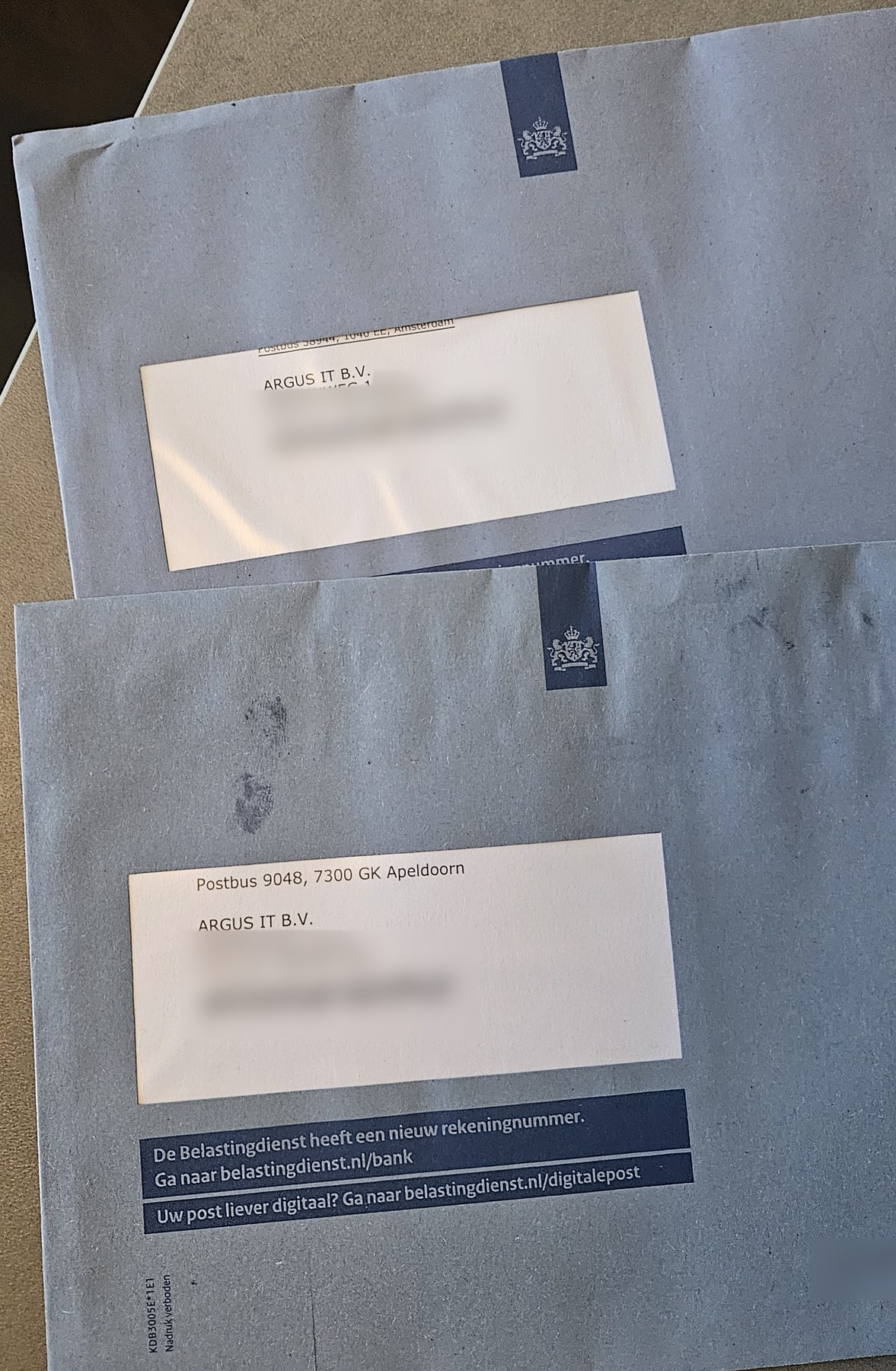
Since starting the company I've had to send a remarkable number of paper letters to the Belastingdienst, the Dutch tax authority, and the g-rekening is a good example. We first opened it only for payroll tax. The VAT number is almost the same as the payroll tax number, it just ends in B01 instead of L01, so I assumed the account could be used for VAT as well. It couldn't: you pay, it gets refunded, and then another paper letter goes to the Belastingdienst to link VAT to the account as well.
Releasing money from the g-rekening doesn't always go smoothly either. The balance builds up because some clients pay a fixed percentage that turns out higher than the payroll tax and VAT actually owed against it. We'd had part of it released before, and that went through without an investigation. This time it was my turn for a tax audit. According to the auditor, that was because of the combination of the g-rekening with our sector classification, as we weren't yet classified as a temp agency. There were almost three weeks between the request and the Belastingdienst's visit, and while that runs the money stays blocked. Our books are in order, so the audit itself was fine. Around noon the Belastingdienst came to our office, the same day there was a draft report, and the conclusion was that there were no indications of improper use of the g-rekening and that the full amount could be released. The conversation also covered our sector classification for employee insurance. Now that we do more detachering than when we started, we fit better in sector 52, temp agencies. We're applying for that reclassification so that we fall under it by mid-2027 at the latest.
How much is paid into the g-rekening is agreed per client. The SNA certification (NEN 4400-1) has so far been the way to get that percentage down. We're getting it now mainly for the Wtta: the inspection for the licence largely checks against the same standards as NEN 4400-1, so with SNA you're already prepared for it. Since we started preparing for it we record hours with start and end times.
Since starting the company I've had to send a remarkable number of paper letters to the Belastingdienst, the Dutch tax authority, and the g-rekening is a good example. We first opened it only for payroll tax. The VAT number is almost the same as the payroll tax number, it just ends in B01 instead of L01, so I assumed the account could be used for VAT as well. It couldn't: you pay, it gets refunded, and then another paper letter goes to the Belastingdienst to link VAT to the account as well.
Releasing money from the g-rekening doesn't always go smoothly either. The balance builds up because some clients pay a fixed percentage that turns out higher than the payroll tax and VAT actually owed against it. We'd had part of it released before, and that went through without an investigation. This time it was my turn for a tax audit. According to the auditor, that was because of the combination of the g-rekening with our sector classification, as we weren't yet classified as a temp agency. There were almost three weeks between the request and the Belastingdienst's visit, and while that runs the money stays blocked. Our books are in order, so the audit itself was fine. Around noon the Belastingdienst came to our office, the same day there was a draft report, and the conclusion was that there were no indications of improper use of the g-rekening and that the full amount could be released. The conversation also covered our sector classification for employee insurance. Now that we do more detachering than when we started, we fit better in sector 52, temp agencies. We're applying for that reclassification so that we fall under it by mid-2027 at the latest.
What's coming: the Wtta and the g-rekening
A lot is changing over the next few years. The Wtta (Wet toelating terbeschikkingstelling arbeidskrachten, the Dutch act introducing a licence for hiring out workers) takes effect on 1 January 2027. From 1 January 2028 you may only hire out staff with a licence from the Nederlandse Autoriteit Uitleenmarkt (NAU), the Dutch staffing market authority. Existing uitleners can register for the transitional arrangement in November and December 2026, the application itself runs from 1 May to 30 June 2027, and enforcement starts in 2028. That enforcement also applies to the hiring party: a client who does business with an uitlener without a licence risks a fine themselves. Companies holding a valid SNA certificate on 30 June 2027 don't need to register for the transitional arrangement, but do have to apply for a licence.
For the licence you need, among other things, a certificate of conduct for legal entities (VOG RP) and a deposit of 100,000 euro. A starting company pays it in two parts, first 50,000 euro and after six months another 50,000 euro, and only gets the money back after four years if it has followed the rules. That's money you can't put into people or growth, and for a company that's a few years old it's a big chunk. Uitleners are exempt if on 31 December 2026 they have been registered as an uitlener for four uninterrupted years, can show they actually hired out staff, and have a clean statement from the Belastingdienst.
The g-rekening is changing too. You hear all sorts of things about it, including that it's going away. That's not true: the state secretary for Finance actually wants to make it mandatory for uitleners, although that won't happen before 1 January 2029. What is changing is hirer's liability. From 2027 the Belastingdienst can hold a hiring client liable for 35 percent of the invoice amount, without first working out what the uitlener actually owes. If the client pays that 35 percent into the g-rekening and meets its administrative obligations, it's in principle indemnified. That applies to tax periods from 2027. The SNA certification stays as a quality mark, but under the Wtta it no longer gives indemnity.
For the licence you need, among other things, a certificate of conduct for legal entities (VOG RP) and a deposit of 100,000 euro. A starting company pays it in two parts, first 50,000 euro and after six months another 50,000 euro, and only gets the money back after four years if it has followed the rules. That's money you can't put into people or growth, and for a company that's a few years old it's a big chunk. Uitleners are exempt if on 31 December 2026 they have been registered as an uitlener for four uninterrupted years, can show they actually hired out staff, and have a clean statement from the Belastingdienst.
The g-rekening is changing too. You hear all sorts of things about it, including that it's going away. That's not true: the state secretary for Finance actually wants to make it mandatory for uitleners, although that won't happen before 1 January 2029. What is changing is hirer's liability. From 2027 the Belastingdienst can hold a hiring client liable for 35 percent of the invoice amount, without first working out what the uitlener actually owes. If the client pays that 35 percent into the g-rekening and meets its administrative obligations, it's in principle indemnified. That applies to tax periods from 2027. The SNA certification stays as a quality mark, but under the Wtta it no longer gives indemnity.
The admin around it
Then two topics that aren't specific to uitleners, but that you'll soon run into as a detachering company. The first is what you give employees on top of their salary, and there are two schemes for that. The werkkostenregeling (work-related costs scheme) is about payroll tax. Within the free allowance, in 2026 2 percent of the taxable wage bill up to 400,000 euro and 1.18 percent above that, you can give tax-free allowances and benefits. If you go over it, you pay an 80 percent final levy on the excess.
For VAT there's also the BUA (Besluit uitsluiting aftrek omzetbelasting, the decree excluding VAT deduction). If an employee receives more than 227 euro excluding VAT in benefits in a year, for example a Christmas hamper or a team outing, you can't deduct the VAT on any of those benefits. We go over that per person anyway, so at the end of the year we correct that VAT in the last return, just like the VAT for private use of the company cars.
The second is invoices through a broker. For assignments through a broker that uses self-billing, the broker issues the invoice on your behalf. You don't book it as your own sales invoice and it doesn't get a number from your own invoice series. You check the hours, the rate and the VAT, and the VAT belongs in the period of the invoice date the broker uses.
For VAT there's also the BUA (Besluit uitsluiting aftrek omzetbelasting, the decree excluding VAT deduction). If an employee receives more than 227 euro excluding VAT in benefits in a year, for example a Christmas hamper or a team outing, you can't deduct the VAT on any of those benefits. We go over that per person anyway, so at the end of the year we correct that VAT in the last return, just like the VAT for private use of the company cars.
The second is invoices through a broker. For assignments through a broker that uses self-billing, the broker issues the invoice on your behalf. You don't book it as your own sales invoice and it doesn't get a number from your own invoice series. You check the hours, the rate and the VAT, and the VAT belongs in the period of the invoice date the broker uses.
If you're going to hire out staff yourself
If your colleagues are going to work at clients, or already do, these are the points I'd check:
- Check whether your KVK registration and SBI code match how you work now, and update them if hiring out staff has become your business model.
- Ask every client for its terms of employment, so you can show the pay package is at least equivalent.
- Find out whether a mandatory pension fund applies to you before you choose a scheme of your own.
- Apply for a g-rekening with both your payroll tax number and your VAT number linked to it, so you don't have to wait for an extra letter.
- Check whether your sector classification for employee insurance is still right.
- If you already hire out staff, register for the Wtta transitional arrangement in November or December 2026, and factor the deposit into your planning.
Sources
- ABU: Cao voor Uitzendkrachten 2026-2028 (Dutch)
- ABU: cao update and status of the AVV request (Dutch)
- Flexmarkt: will the minister declare the staffing cao generally binding? (Dutch)
- De Zaak: new cao and pension scheme for temporary workers (Dutch)
- CNV: improved pension scheme for temporary workers, old and new contribution (Dutch)
- AWVN: PAWW contribution stays at 0.1% in 2026 (Dutch)
- Rijksoverheid: consultation on changing the requirements for hiring out staff (October 2026, Dutch)
- SRA: phased entry into force of the Wtta (Dutch)
- KVK: Waadi, hiring out or hiring in staff (Dutch)
- SFU collective agreement 2026 (SFU contribution, Dutch)
- KVK: chain liability and a G-rekening (Dutch)
- Belastingdienst: chain liability (Dutch)
- Belastingdienst: applying for, using, releasing or closing a g-rekening (Dutch)
- Belastingdienst: g-rekening application form (Dutch)
- Ondernemen met personeel: what a g-rekening is and how it works (Dutch)
- Moore DRV: what the Wtta means for hirer's liability from 2027 (Dutch)
- Rendement: uitleners will have to use a g-rekening (Dutch)
- SRA: simplified hirer's liability from 2027 (Dutch)
- ABU: practical guide to getting ready for the Wtta (Dutch)
- MKB Servicedesk: how the werkkostenregeling works in 2026 (Dutch)
- Belastingdienst: staff benefits and business gifts (BUA, Dutch)
